
10-Minute Demo
Experimental Project
AgentPay has not undergone an independent security audit. Do not use with production funds. This walkthrough uses testnets and test tokens only.
What You Will See
A single demo script runs locally on your machine, walking sequentially through three real-world scenarios:
| Scenario | What Happens | Firewall Response |
|---|---|---|
| 1. Normal Payment | Agent purchases an NVDA market quote priced at $0.05 | Approved → Signed → Settled, agent receives data |
| 2. Over-Budget Attempt | Agent calls a heavy computing endpoint priced at $2.50 | Single cap is $0.10; rejected immediately, no signature generated |
| 3. Runaway Loop | Agent gets trapped in an infinite retry loop | Limit is 5 RPM; circuit breaker trips and blocks all subsequent calls |
The demo firewall is configured with:
Single Cap: $0.10 | 24-Hour Budget: $1.00 | Max 5 Requests / MinutePrerequisites
- Python 3.10+,
make, andgit - Clone the repository:
git clone https://github.com/july-whj/AgentPay.git
cd AgentPay- Refer to the repository README for dependency installation.
Step 1: Run In-Memory Simulation (Recommended First)
make demoThis mode simulates the complete payment chain in memory—no network calls, zero gas spent, no test tokens required. It completes in seconds with 100% deterministic results.
Phase 1: Normal Micro-Payment
>>> [PHASE 1] Normal Micro-Payment with On-Chain Settlement <<<
Agent requests paid market data for 'NVDA' ($0.05 USDC).
✓ Tool Response Received: {'ticker': 'NVDA', 'price': 142.5, ...}
[Facilitator] ON_CHAIN_TRANSACTION_CONFIRMED
The agent executed a standard tool call, while under the hood:
- Upstream returned an HTTP 402 "Payment Required" challenge.
- The firewall evaluated: $0.05 is within single cap, budget available → Approved.
- Local signer generated an off-chain authorization transfer signature.
- Client retried with the payment header and received data.
- The facilitator submitted the authorization for settlement.
Notice this line in the log:
"gasChargedToBuyer": "0.0000 ETH (Free EIP-3009 Transfer)"The buyer's wallet only holds USDC; it does not need ETH for gas (see Gasless Auth (EIP-3009)).
Phase 2: Exceeding Single-Transaction Cap
[BuyerFirewall] POLICY_VIOLATION_INTERCEPTED
  "errorCode": "SINGLE_TX_CAP_EXCEEDED",
  "requestedAmountUsdc": "2.50",
  "maxAllowedPerTxUsdc": "0.10",
  "action": "PAYMENT_ABORTED_SAFELY",
  "walletFundsDrained": "0.00 USDC"
The endpoint asked for $2.50, but the single cap is $0.10. The firewall rejected the request before reaching the signer. With no signature generated, zero funds can leave the wallet.
Notice the toolObservation line in the log: the rejection reason is returned directly to the agent. The agent understands why it was blocked and can choose an alternative strategy, but has no mechanism to bypass or modify the policy.
Phase 3: Runaway Loop Intercepted by Circuit Breaker
[BuyerFirewall] CIRCUIT_BREAKER_TRIPPED
  "iteration": 5,
  "breakerState": "OPEN",
  "reason": "CIRCUIT_MAX_RPM_EXCEEDED (Max 5 RPM exceeded)",
  "cooldownSeconds": 300
✗ Loop iteration #5 BLOCKED by Circuit Breaker
The agent enters a runaway loop, firing 8 rapid invocations. The first 4 succeeded; combined with Phase 1, 5 payments occurred within one minute. On iteration 5, the circuit breaker tripped to OPEN, immediately blocking all subsequent invocations with a 300-second cooldown.
This is how the "$1,800/hour runaway loop" described in Why We Need a Financial Firewall is halted in seconds.
Final Audit Summary
Calls Attempted:             10
Successful Paid Calls:       5
Over-Budget Blocks:          1
Runaway Loop Blocks:         4
Total Spend Attempted:       $2.63 USDC
Actual Funds Debited:        $0.09 USDC
Total Funds Saved by AgentPay: $2.54 USDC
Reconciling the numbers:
| Metric | Details |
|---|---|
| 10 calls attempted | Phase 1 (1) + Phase 2 (1) + Phase 3 (8) |
| 5 successful paid calls | Phase 1 (1) + First 4 loop iterations |
| 5 blocked calls | Over-cap (1) + Circuit breaker (4) |
| Actual debited: $0.09 | Total of the 5 authorized micro-payments |
| Saved: $2.54 | $2.50 over-cap call + 4 blocked loop iterations |
Important note: The 4 micro-payments executed before the circuit breaker tripped are non-refundable. The firewall caps maximum loss; it does not reduce authorized spending to zero.
Step 2 (Optional): Real On-Chain Settlement
To see transactions broadcast and confirmed on a public blockchain explorer:
make demo-liveThis mode broadcasts genuine transactions to the Arbitrum Sepolia testnet.
Additional Prerequisites
- Facilitator wallet: Funded with a small amount of Arbitrum Sepolia testnet ETH for gas.
- Buyer wallet: Funded with Circle testnet USDC.
- Configure private keys and RPC in your environment according to README instructions.
Do Not Use Public Keys
Many public tutorials and local dev frameworks embed publicly known private keys. Bots constantly monitor those addresses. Always generate brand-new test keys for live mode and fund only with testnet faucet tokens. Never use test keys on mainnet.
Verify on Arbiscan
Upon completion, Phase 1 outputs a transaction hash and Arbiscan explorer link:
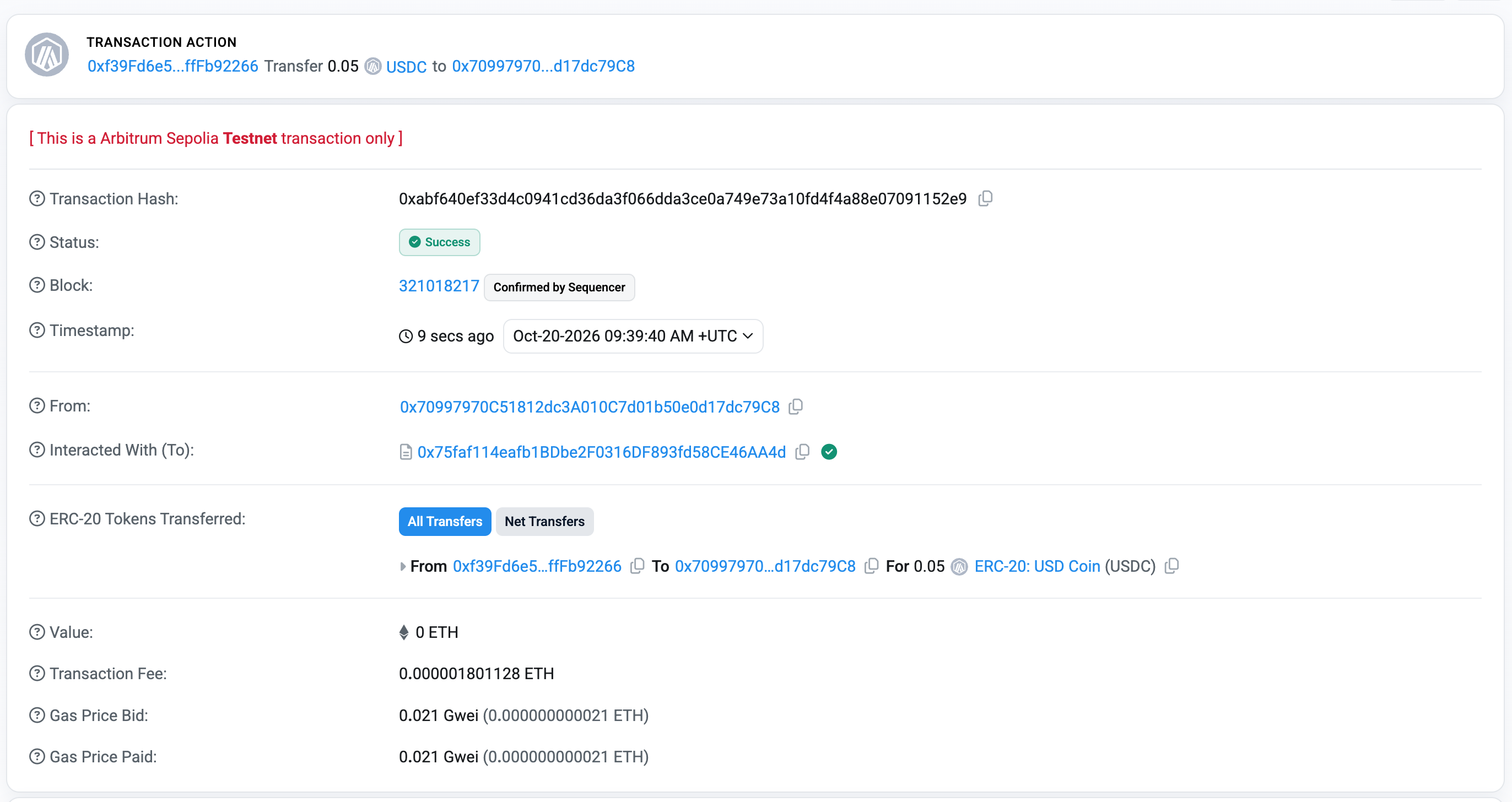
How to interpret the explorer fields:
| Arbiscan Field | Value | Meaning |
|---|---|---|
| Status | Success | Transaction executed successfully on-chain |
| ERC-20 Tokens Transferred | 0.05 USDC from buyer to seller | Actual amount spent, matching demo logs |
| From | Facilitator wallet address | Transaction broadcast and gas paid by Facilitator, not Buyer |
| Transaction Fee | ~0.0000018 ETH | Gas absorbed by the facilitator; 0 ETH for buyer |
| Value | 0 ETH | Native ETH transferred is zero; only USDC moved |
| Timestamp | Matches terminal log | Real-time on-chain confirmation |
This confirms the zero-gas model: the buyer authorizes the transfer with an off-chain signature, while the facilitator broadcasts the transaction and pays the network gas fee.
Live Mode Notice: "nonce too low"
During live mode settlement, you may occasionally observe:
Failed to broadcast settlement tx: RPC error -32000: nonce too low ...
Settlement submission failed ... Facilitator error 409: Nonce has already been submitted for settlement
nonce too low indicates that the facilitator transaction nonce was preempted on-chain. This happens when the same wallet broadcasts multiple transactions concurrently or the address is used by multiple processes.
In such cases, affected settlements await reconciliation rather than immediate broadcast, illustrating Timeout Is Not Failure: "Submission failure" does not mean "transaction does not exist"; state must be verified prior to re-transmission.
Verification Checklist
After running the demo, verify that:
- [ ] Phase 1: Market data returned; buyer gas charged is 0
- [ ] Phase 2: Intercepted with
SINGLE_TX_CAP_EXCEEDED; zero funds left wallet - [ ] Phase 3: Blocked on iteration 5 with circuit breaker state
OPEN - [ ] Audit summary: Total funds saved exceeds actual debited funds
- [ ] (Live mode): Phase 1 transaction verified on Arbiscan
Try Experimenting
Open examples/runaway-agent/demo.py and tweak the firewall parameters (single cap, 24-hour budget, max RPM):
- Increase single cap to $3.00 and re-run. Does Phase 2 still get blocked? If so, which rule triggers?
- Increase max RPM to 20. At which iteration does the circuit breaker trip?
- Reduce 24-hour budget to $0.05. How does Phase 3 behave?
Observe the errorCode in terminal logs to see which policy rule intercepted each request.
Next Steps
- Understand firewall architecture: Why We Need a Financial Firewall
- Learn how concurrent budgets avoid overspending: Budget Reservation
- Configure paid routes in Web Console: First Paid Route